Hi, to confirm your appointment you will be redirected to the dedicated booking form.


RAG (Retrieval-Augmented Generation): Enhancing AI with Real-Time Data Retrieval

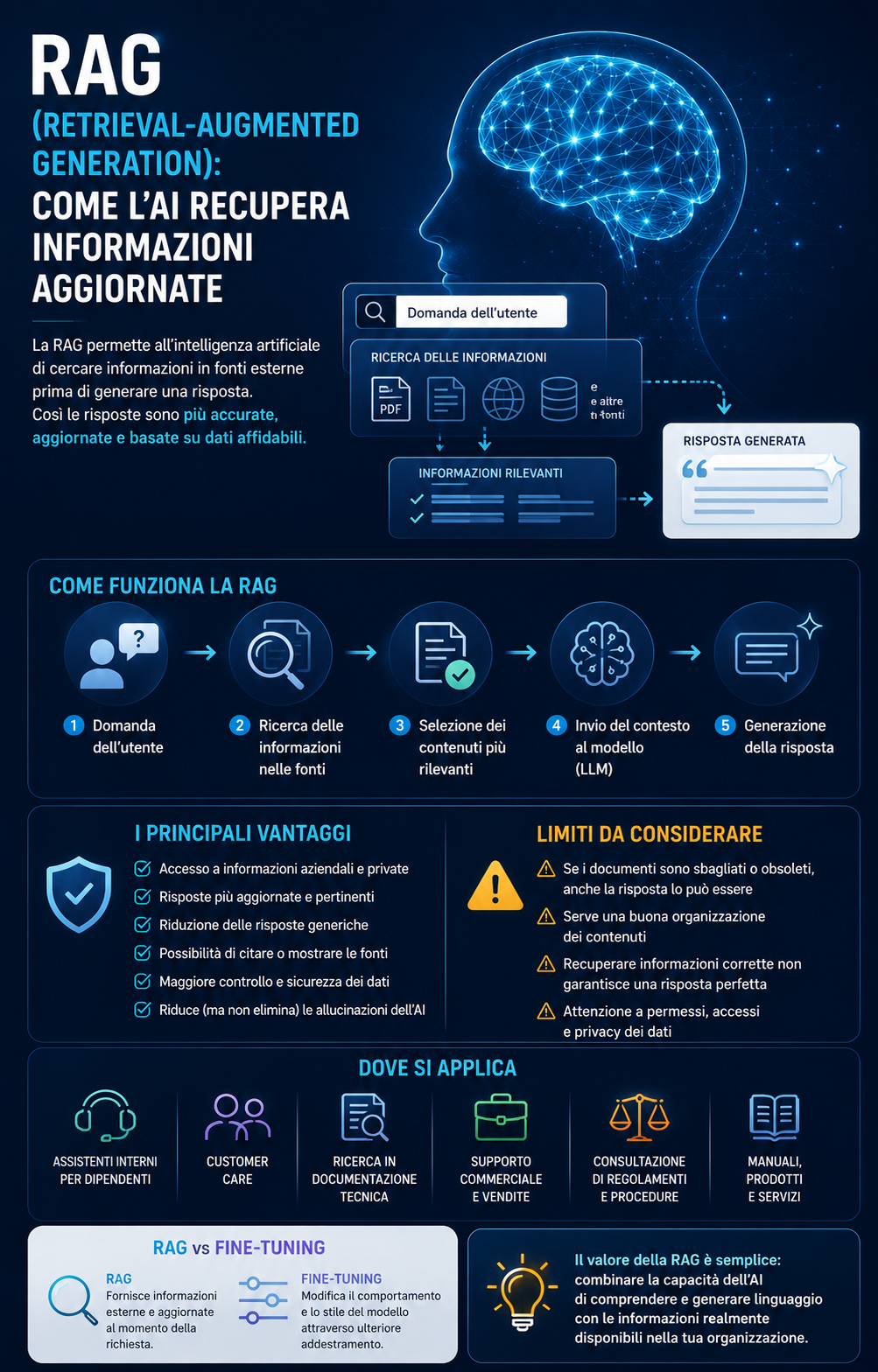
In the rapidly evolving landscape of artificial intelligence, the ability to access and utilize up-to-date information is paramount. This is where Retrieval-Augmented Generation (RAG) comes into play, revolutionizing how AI systems can enhance their response accuracy by retrieving external data. Unlike traditional AI models, which rely solely on pre-trained data, RAG enables a dynamic search for the most current information before generating responses. This capability is particularly crucial in business environments where procedures, regulations, and facts change frequently, necessitating an AI that can keep pace with the latest developments.
But what exactly is RAG, and how does it function within the realm of AI? At its core, Retrieval-Augmented Generation is a sophisticated technique that merges the retrieval of relevant data with the generative capabilities of AI. This two-phase process ensures that the AI does not just regurgitate learned information but adapts its responses based on the latest data retrieved from specific, controlled sources. For instance, when an employee queries about the updated reimbursement procedures, a RAG-enabled system would first search through the latest company documents to find the relevant information and then tailor its response based on this data.
The sources for RAG are diverse and can include PDF documents, manuals, databases, intranets, FAQs, and more, emphasizing that RAG is not about unrestricted internet searches but about accessing precise and secure information repositories. Moreover, the integration of technologies like embedding and semantic search allows RAG systems to understand and match the content semantically, even if the exact words are not used in the queries. This is further supported by vector databases, which facilitate the rapid identification of the most pertinent information.
When comparing RAG to traditional Large Language Models (LLMs) or fine-tuning approaches, the differences are stark. While LLMs depend on their training data and the immediate context, RAG systems actively fetch specific and updated information, leading to more accurate and relevant responses. This capability not only enhances the functionality of AI in business applications but also addresses common issues such as AI hallucinations, where the model generates incorrect or nonsensical information.
Despite its advantages, RAG comes with its set of challenges. The accuracy of the responses heavily depends on the relevance and currency of the retrieved documents. Poorly organized knowledge bases or outdated documents can diminish the effectiveness of a RAG system. Moreover, ensuring proper permissions and data security is essential to maintain the integrity of the system.
The practical applications of RAG are vast, ranging from internal employee assistants to customer care, and from managing extensive technical documentation to automating complex business procedures. By understanding the operational sequence of RAG—from the initial query, through data retrieval and content selection, to response generation—businesses can leverage AI more effectively, ensuring that their AI systems are not just smart, but also well-informed and up-to-date.
As we delve deeper into the specifics of RAG, we will explore the following key areas:
- Understanding Retrieval-Augmented Generation (RAG)
- How RAG Works: From Query to Response
- Sources and Technologies Behind RAG
- Comparing RAG with Traditional LLMs and Fine-Tuning
- Advantages, Limitations, and Practical Applications of RAG
Understanding Retrieval-Augmented Generation (RAG)
Retrieval-Augmented Generation (RAG) is a sophisticated AI technique that enhances the capabilities of language models by enabling them to access and utilize external information sources when generating responses. This method addresses a fundamental limitation of many AI systems: their responses are often only as good as the data they were trained on, which may not include the most recent or specific information needed.
How RAG Works
RAG operates in two main phases. First, when a query is received, the system searches through connected external sources to retrieve relevant information. This could be anything from company manuals to internal databases. After retrieving the necessary data, the AI then uses this information to generate an informed and accurate response.
Practical Example of RAG in Action
Consider an employee asking, “What is the updated procedure for reimbursements?” Instead of generating a response based on potentially outdated training data, a RAG system first searches the company’s most current documents to find the updated procedure. It then crafts a response based directly on this retrieved information, ensuring the reply is both accurate and up-to-date.
Information Sources for RAG
RAG systems can be connected to a variety of information repositories, including:
- PDF documents
- Manuals
- Knowledge bases
- Databases
- Intranet sites
- FAQs
- Technical documentation
- Company procedures
It’s crucial to note that RAG does not necessarily mean searching the Internet at large but rather retrieving information from specific, controlled sources within an organization or predefined database.
Embedding and Semantic Search
In RAG systems, embedding and semantic search play critical roles. These technologies allow the system to understand and match the content in documents with the query, even if the exact words are not used. This is achieved by transforming the content into vector representations, which can then be compared for relevance to the query.
Vector Databases
Vector databases are utilized within RAG systems to efficiently store and retrieve these vector representations. This enables the AI to quickly find the most relevant content in response to a query, significantly speeding up the information retrieval process.
Comparison with Standalone Large Language Models (LLM)
Unlike standalone LLMs, which generate responses based solely on pre-trained data and the immediate context, RAG systems enhance response accuracy by incorporating specific, real-time information retrieved from external sources. This capability allows RAG-equipped AIs to provide more precise and updated answers than their standalone counterparts.
How RAG Works: From Query to Response
Understanding the operational flow of Retrieval-Augmented Generation (RAG) is crucial for leveraging its capabilities in business environments. This section breaks down the sequence from the initial user query to the final response generation, illustrating how RAG integrates with existing AI technologies to enhance information retrieval and response accuracy.
User’s Question
The process begins when a user poses a question. For instance, an employee might ask, ‘What is the updated procedure for reimbursements?’. This question triggers the RAG system to initiate a search for relevant information.
Information Search
The RAG system scans through connected data sources, which could include PDF documents, company manuals, internal databases, and more. The goal is to find data that can answer the user’s question.
Selection of the Most Relevant Content
Once potential sources are identified, the system uses advanced algorithms to determine which content is most relevant to the query. This involves techniques like semantic search, where the system understands the context of the content beyond exact keyword matching.
Sending the Context to the Model
Relevant information is then converted into a format that the AI can process. This typically involves creating embeddings or vector representations of the text, which are then fed into the AI model. This step is crucial as it bridges the gap between raw data and a format that the AI can interpret.
Response Generation
Armed with the context, the AI model generates a response that is informed by the most up-to-date and relevant information available. This response is not just based on the AI’s pre-existing knowledge or training data, but is augmented by the specific data retrieved in response to the query.
This sequence ensures that the responses provided by a RAG system are not only accurate but also tailored to the specific needs and current realities of the business. By integrating retrieval and generation, RAG systems provide a powerful tool for businesses to harness the full potential of artificial intelligence in managing and utilizing their knowledge assets.
Sources and Technologies Behind RAG
Retrieval-Augmented Generation (RAG) leverages a variety of sources and advanced technologies to enhance the capabilities of AI systems. Understanding these components is crucial for implementing RAG effectively in business environments.
Key Sources for RAG
RAG systems can integrate with a wide range of data repositories to retrieve the most relevant and updated information. These sources include:
- PDF documents
- Manuals
- Knowledge bases
- Databases
- Intranet sites
- FAQs
- Technical documentation
- Company procedures
By connecting to these controlled sources, RAG ensures that the AI accesses precise and authoritative data, rather than relying on potentially unreliable internet searches.
Technological Foundations of RAG
The effectiveness of a RAG system hinges on two technological pillars: embedding and vector databases.
Embedding and Semantic Search
In RAG systems, embedding technology is used to transform textual content into numerical representations, known as vectors. This process enables the AI to perform semantic searches—finding information that conceptually matches the query, even if the exact words are not used in the documents.
Vector Databases
Vector databases play a critical role in RAG by storing the embeddings and facilitating rapid retrieval of the most relevant content. These databases are designed to handle high-dimensional data and support efficient similarity searches, which are essential for the quick selection of pertinent information.
Together, these technologies allow RAG systems to provide precise, contextually appropriate responses by effectively searching through and utilizing a vast array of company-specific documents and data.
Comparing RAG with Traditional LLMs and Fine-Tuning
Understanding the distinctions between Retrieval-Augmented Generation (RAG), traditional Large Language Models (LLMs), and the process of fine-tuning is crucial for leveraging AI in business environments. Each approach has its unique strengths and applications, particularly in how they handle information and generate responses.
Traditional LLMs
Traditional LLMs, such as GPT-3, are pre-trained on a vast corpus of data and generate responses based on patterns and information learned during this training phase. They excel in generating coherent and contextually appropriate text but are limited to the data they were trained on. This means they might not have access to the most current or specific information needed for particular business applications.
RAG Systems
Unlike traditional LLMs, RAG systems do not solely rely on pre-trained data. Instead, they actively retrieve information from external sources at the time of the query. This process involves two main steps: first, the AI searches through connected data sources like company databases or knowledge bases to find relevant information; then, it uses this information to generate a response. This capability allows RAG systems to provide answers that are not only contextually relevant but also up-to-date and specific to the organization’s current needs and documents.
Fine-Tuning
Fine-tuning, on the other hand, involves additional training of a pre-existing LLM on a specific dataset to modify its behavior or improve its performance on particular tasks. This method is useful for tailoring the model’s responses to reflect the style, terminology, and nuances of a specific domain or company. However, unlike RAG, fine-tuning does not inherently equip the model to access or retrieve new or updated information post-training.
Practical Implications in Business
In a business context, the ability of RAG to integrate real-time data retrieval with AI-driven response generation makes it exceptionally valuable. For instance, in customer service, a RAG-enhanced chatbot can access the latest product information or customer data to provide accurate support, something a solely fine-tuned or traditional LLM cannot achieve on its own. This integration reduces the risk of providing outdated or irrelevant information, a common limitation in static AI models.
Ultimately, choosing between RAG, traditional LLMs, and fine-tuning depends on the specific needs and goals of the business. While traditional LLMs and fine-tuning are powerful tools for generating human-like text, RAG’s ability to fetch and utilize the most current data makes it indispensable for applications requiring high accuracy and up-to-date knowledge.
Advantages of Retrieval-Augmented Generation
Retrieval-Augmented Generation (RAG) offers several compelling advantages for businesses. Firstly, it provides access to the most current company information, ensuring that responses are not only accurate but also up-to-date. This reduces the likelihood of generic responses and enhances the ability of AI systems to cite or show sources, thereby increasing transparency and trust. Moreover, RAG allows for greater control over the data used by AI, tailoring its use to private or specialized knowledge that is critical to company operations.
Limitations of RAG
Despite its benefits, RAG also has limitations. If the documents or data sources it retrieves are outdated or incorrect, the generated responses will be similarly flawed. Additionally, a poorly organized document system can diminish the effectiveness of a RAG system, as it relies heavily on the quality of the source material. Furthermore, while RAG can significantly reduce AI hallucinations—where AI generates plausible but incorrect or nonsensical information—it does not eliminate them entirely. Effective implementation also requires stringent controls on permissions and data access to ensure security and compliance.
Practical Applications of RAG in Business
RAG systems find numerous applications in various business contexts. They serve as internal assistants for employees, helping them navigate company procedures, access technical documentation, or manage manuals more efficiently. In customer care, RAG can provide support by accessing up-to-date product information or troubleshooting guides. Additionally, RAG systems enhance research capabilities in technical documentation and support commercial teams by providing quick access to regulations, product details, and service information. This makes RAG an invaluable tool for businesses where information is frequently updated, such as legal, financial, and technology sectors.
Business Use Examples
- Internal assistant for employees
- Customer care support
- Research and consultation in technical documentation
- Commercial support and product service assistance
- Regulatory compliance and procedure management
