Hi, to confirm your appointment you will be redirected to the dedicated booking form.


Process Automation with AI: Unveiling Practical Insights for Business Efficiency

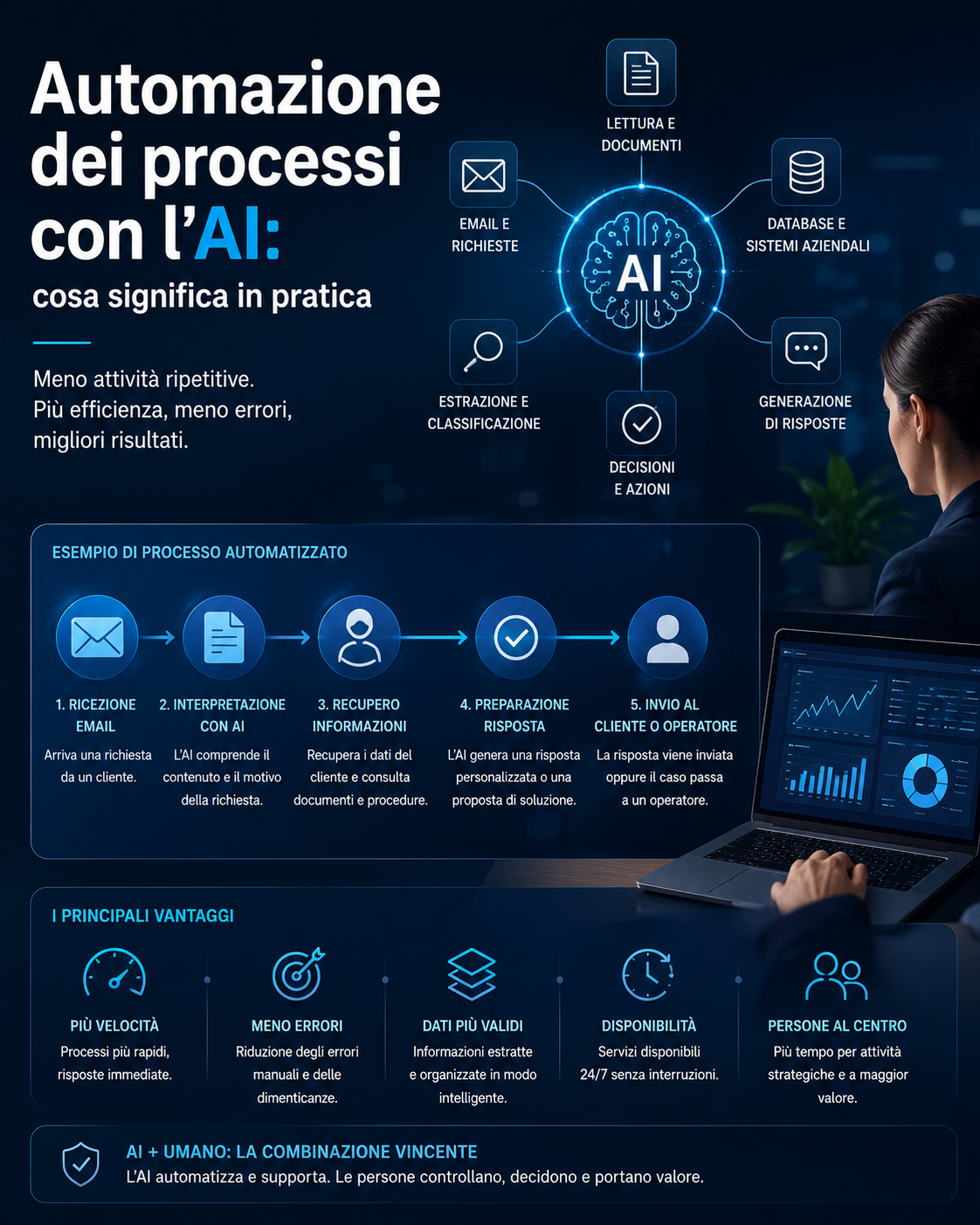
In today’s rapidly evolving digital landscape, the integration of artificial intelligence (AI) into business processes is not just a trend but a substantial shift towards smarter automation. Process automation with AI, or intelligent process automation, goes beyond traditional methods by not only automating routine tasks but also by bringing intelligence to operations that require adaptability and cognitive understanding. This transformation is pivotal for businesses aiming to enhance efficiency and maintain competitiveness in the digital age.
Automating a business process with AI involves more than just implementing a chatbot or a simple script; it encompasses the creation of AI agents that can interpret, analyze, and respond to data in a way that mimics human decision-making but with greater speed and accuracy. Unlike traditional automation that relies on predefined rules and structured inputs, automation with artificial intelligence can process unstructured data, understand natural language, and make decisions based on complex, dynamic inputs.
For instance, consider the difference in approaches: a traditional automated system might be programmed to perform straightforward tasks such as ‘if a completed form arrives, save it in the correct folder.’ In contrast, an AI-driven system could analyze an incoming email, determine the nature of the request, extract essential data, classify the inquiry, and route it to the appropriate department without human intervention. This level of automation not only speeds up the process but also reduces the likelihood of errors and enhances the overall customer experience.
AI’s capability to perform a variety of tasks such as reading documents, extracting and analyzing data, and even making informed decisions introduces a new era of business automation where processes are not just automated but are intelligently managed. This leads to a more dynamic, responsive, and efficient workflow, termed as AI workflow, which can significantly alter how businesses operate internally and interact with their customers.
Sections to explore further in this article include:
- Understanding Process Automation with AI
- Traditional Automation vs. AI-Driven Automation
- Core Functions of AI in Process Automation
- Practical Applications and Benefits of AI Automation
- Challenges and Best Practices in AI Automation
Understanding Process Automation with AI
When we talk about process automation with AI, we’re referring to a significant evolution from traditional automation systems. Unlike conventional methods that rely on predefined rules and structured data, AI-driven automation can interpret unstructured information, adapt to new situations, and make informed decisions based on real-time data.
Traditional Automation vs. AI-Driven Automation
Traditional automation works on a fixed set of rules. For example, it might automatically save a completed form to a designated folder. This type of automation is predictable and rigid, suitable for repetitive tasks but unable to handle anything outside its predefined parameters.
In contrast, automation with AI involves systems that can understand the context of data, such as the content of an email, and make decisions about how to process it. For instance, AI can read an email, determine the nature of the request, extract relevant data, classify the type of inquiry, and route it to the appropriate department.
Capabilities of AI in Process Automation
- Reading and interpreting emails and documents
- Extracting key information from unstructured data
- Classifying types of requests and inquiries
- Summarizing content for quicker decision-making
- Generating responses based on the extracted information
- Consulting databases and internal knowledge bases
- Integrating with existing APIs and business software
- Suggesting or executing subsequent actions in a workflow
Example of AI in Business Process Automation
Consider a scenario where a customer sends an email with a service request. Here’s how AI automation might handle it:
- The AI system reads and interprets the email content.
- It identifies the customer and understands the specific request.
- The system retrieves relevant customer data from the CRM.
- AI consults internal documents or procedures to gather additional information.
- Based on this data, the AI prepares a response or a report.
- If necessary, the case is escalated to a human operator for further action.
This integration of AI not only speeds up the process but also ensures accuracy and efficiency, reducing the workload on human employees and allowing them to focus on more complex tasks.
Traditional Automation vs. AI-Driven Automation
Understanding the distinction between traditional automation and AI-driven automation is crucial for businesses looking to enhance their operational efficiency. Traditional automation operates under fixed, predefined rules. For instance, it might automatically save a completed form in a designated folder based on specific criteria. This form of automation excels in predictable, structured environments where tasks are consistent and deviations are minimal.
In contrast, AI-driven automation, or intelligent automation, introduces a layer of cognitive processing that allows systems to handle unstructured information, interpret natural language, and manage unpredictable situations. This type of automation is not limited to rigid rules but can learn from data patterns and make informed decisions.
Example of Traditional vs. AI-Driven Automation
- Traditional Automation: If a completed form arrives, the system automatically saves it in the correct folder.
- AI-Driven Automation: When an email arrives, the AI system reads and understands the content, extracts important data, classifies the request based on urgency and context, and routes it to the appropriate department.
This capability to process and react to new information in real-time makes AI-driven automation particularly valuable in dynamic business environments where adaptability and responsiveness are key.
Core Functions of AI in Process Automation
Integrating artificial intelligence (AI) into business processes transforms traditional automation by enabling systems to handle complex and dynamic tasks. Here, we explore the essential functions that AI performs in process automation, illustrating how it enhances operational efficiency and decision-making.
Reading and Understanding Documents
AI technologies are adept at processing vast amounts of unstructured data. They can read and interpret documents, emails, and forms, extracting relevant information. This capability is crucial in environments where data input varies significantly, such as in customer service or legal document handling.
Data Extraction and Classification
Once AI systems understand the content, they can extract key pieces of information. This process involves identifying specific data points like dates, names, monetary values, or any relevant details based on the context of the process. Following extraction, AI can classify the information into predefined categories, aiding in efficient data management and retrieval.
Interaction with Business Software
AI can seamlessly interact with other business applications such as Customer Relationship Management (CRM) systems, Enterprise Resource Planning (ERP) software, and various databases. For example, after identifying a customer’s issue from an email, AI can retrieve the customer’s history from the CRM, check product availability in the ERP, and update records accordingly.
Decision Support and Next Steps
Perhaps one of the most significant advantages of AI in process automation is its ability to not only perform predefined tasks but also to suggest or trigger subsequent actions based on the data analysis. This might include sending automated responses, escalating issues to human supervisors, or initiating new business processes.
Summarization and Response Generation
AI technologies, especially those leveraging natural language processing, can summarize lengthy documents or correspondences, making it easier for human operators to review and understand the essentials quickly. Moreover, AI can generate responses or complete documents based on the templates and information it has learned from previous interactions.
Practical Applications and Benefits of AI Automation
Integrating artificial intelligence into business processes transforms traditional operations into dynamic, intelligent workflows. This section explores the practical applications and tangible benefits of AI automation across various business functions.
Key Business Functions Enhanced by AI Automation
- Customer Care: AI can automate responses to common inquiries, escalate complex issues, and provide personalized customer interactions.
- Document Management: AI systems can automatically classify, store, and retrieve documents based on content and context.
- Sales and Marketing: AI helps in predicting customer behaviors, automating lead scoring, and personalizing marketing campaigns.
- Human Resources: From screening resumes to automating routine inquiries about policies and benefits, AI streamlines HR processes.
- Logistics: AI optimizes routing, manages inventory, and predicts maintenance for logistics operations.
Advantages of Implementing AI in Business Processes
Adopting AI automation in business processes offers numerous advantages that enhance operational efficiency and decision-making:
- Increased Efficiency: AI automation significantly reduces the time spent on repetitive tasks, allowing employees to focus on more strategic activities.
- Accuracy and Consistency: AI systems minimize human error and deliver consistent outcomes, crucial in areas like data entry and regulatory compliance.
- Scalability: AI can handle increasing volumes of work without the need for proportional increases in staff, thus supporting business growth without equivalent cost increases.
- 24/7 Operation: Unlike human workers, AI systems can operate continuously, providing round-the-clock service especially beneficial in customer care and monitoring operations.
- Data-Driven Insights: AI’s ability to analyze large volumes of data can uncover insights that drive better business decisions.
Limitations and Considerations
While AI automation offers significant benefits, there are limitations and risks that businesses must manage:
- Potential for Errors: AI systems, especially those involving machine learning, can make errors due to biases in data or unexpected input variations.
- Security and Privacy Concerns: Handling sensitive data with AI solutions requires robust security measures to prevent data breaches and ensure compliance with privacy laws.
- Continuous Monitoring and Maintenance: AI systems require ongoing monitoring to ensure they are functioning correctly and adapting to new data or conditions.
- Human Oversight: Certain decisions, particularly those involving ethical considerations, should remain under human control to ensure accountability and compliance.
By understanding these applications, benefits, and limitations, businesses can more effectively integrate AI into their operations, achieving not only greater efficiency but also enhanced strategic capabilities.
Challenges and Best Practices in AI Automation
Integrating artificial intelligence into business processes is not without its challenges. However, understanding these hurdles and implementing best practices can significantly enhance the effectiveness of AI automation.
Common Challenges in AI Automation
- Data Quality and Availability: AI systems require high-quality data to function effectively. Inadequate or erroneous data can lead to poor decision-making and automation failures.
- Integration Complexity: Seamlessly integrating AI with existing business systems (like CRM and ERP) can be technically challenging, requiring sophisticated API management and middleware solutions.
- Security and Privacy Concerns: Automating processes with AI involves handling sensitive data, which raises concerns about security breaches and privacy violations.
- Scalability Issues: As business needs grow, AI systems must scale accordingly, which can be a technical and resource-intensive challenge.
- Human Resistance to Change: Employees may resist adopting AI solutions due to fear of job displacement or mistrust in automated systems.
Best Practices for Implementing AI Automation
- Ensure Data Integrity: Invest in robust data management practices to maintain the accuracy and consistency of data fed into AI systems.
- Focus on Scalable Architectures: Design AI solutions with scalability in mind, using cloud services and modular architectures that can grow with your business.
- Strengthen Security Measures: Implement advanced security protocols and regular audits to protect data and comply with regulatory requirements.
- Promote Transparency and Training: Educate employees about the benefits and operations of AI systems to foster acceptance and facilitate smoother transitions.
- Maintain Human Oversight: Implement a ‘human in the loop’ approach to ensure critical decisions are reviewed and validated by human operators, enhancing the reliability of automated processes.
By addressing these challenges and adhering to best practices, businesses can leverage AI automation to enhance efficiency, reduce errors, and free up human workers for more complex tasks, ultimately driving significant business value.
