Hi, to confirm your appointment you will be redirected to the dedicated booking form.


LLM vs Traditional Chatbot: Exploring the Core Differences in AI Chatbots

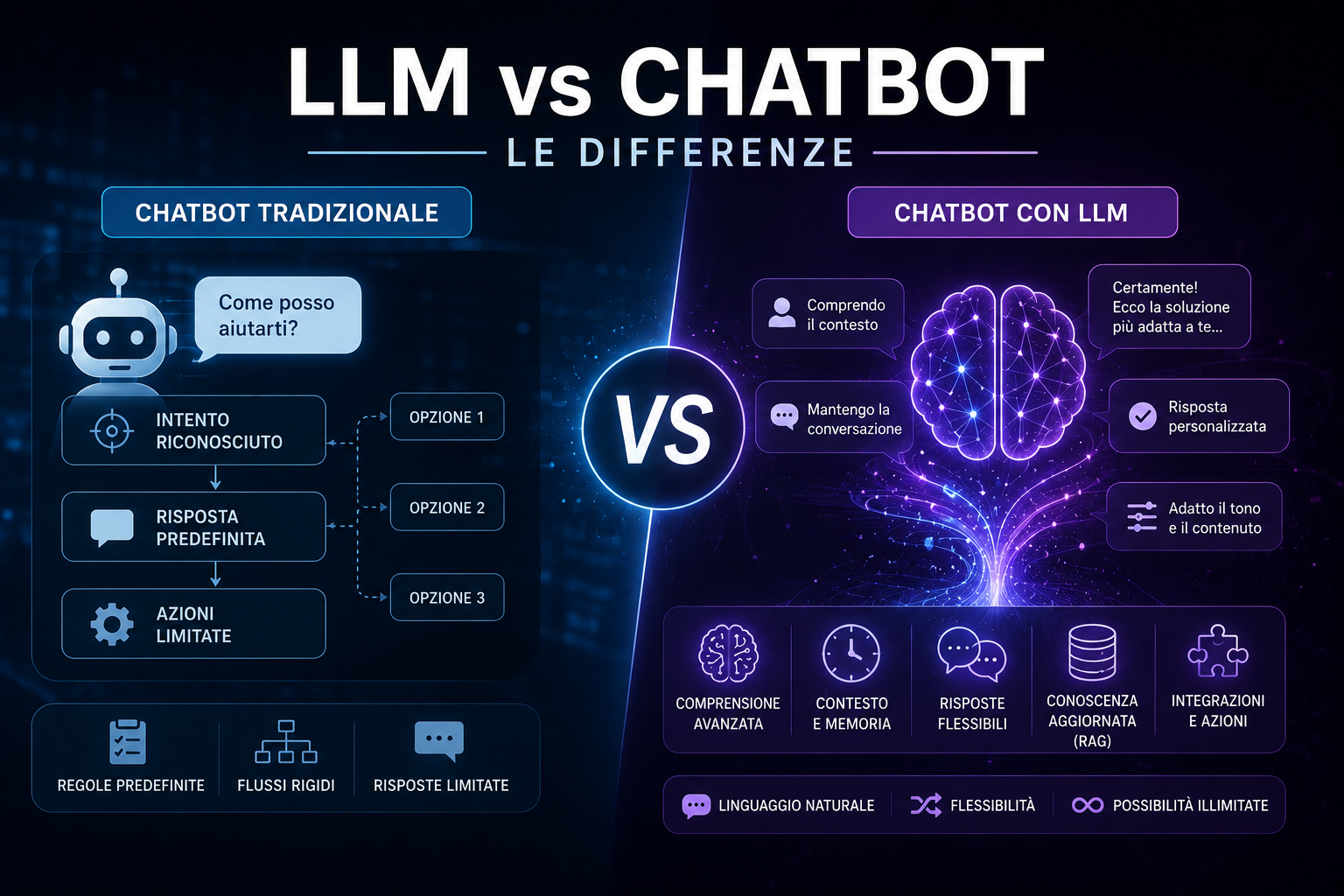
At first glance, traditional chatbots and those based on Large Language Models (LLMs) might appear to serve the same function: facilitating conversation via digital interfaces. However, the underlying technologies that power these tools differ significantly, impacting everything from user interaction to backend integration. This article delves into these differences, providing clarity on how each technology operates and their respective advantages and limitations within business applications.
Traditional chatbots, which are prevalent in customer service applications, operate on a more rigid, rule-based system. These systems are designed to interpret specific user inputs and respond with pre-configured answers. For example, if a customer types ‘I want to check my order’, the chatbot is programmed to recognize this request and follow a predetermined path to provide the information. This method, while reliable, offers limited flexibility and requires extensive setup to cover all potential user inquiries.
In contrast, chatbots powered by LLMs such as GPT (Generative Pre-trained Transformer) offer a more dynamic approach. These models are trained on vast datasets, enabling them to understand and generate human-like text. This capability allows LLM-based chatbots to handle a variety of input phrases, maintain conversation context, and even generate informative and contextually relevant responses on the fly. The flexibility and adaptability of LLMs represent a significant advancement over traditional chatbot technology.
Despite these advancements, it’s crucial to understand that chatbots and LLMs are not synonymous. A chatbot is typically the user-facing interface, while an LLM can serve as the intelligent backend. This distinction is important for businesses considering integrating these technologies, as each serves different roles within the customer interaction process.
Sections to follow will further explore these distinctions:
- Understanding the Basics: Traditional Chatbots vs. LLMs
- How Traditional Chatbots Work: Rules and Predefined Responses
- The Capabilities of Large Language Models in Chatbots
- Comparative Analysis: Flexibility, Context Management, and Integration
- Choosing the Right Technology: Use Cases and Limitations
Understanding the Basics: Traditional Chatbots vs. LLMs
While both traditional chatbots and LLM-based systems serve as tools for interaction, their underlying technologies and capabilities differ significantly. This section explores these differences in detail, providing insights into how each system processes and responds to user inputs.
Traditional Chatbots: Rule-Based Interaction
Traditional chatbots operate on a rule-based system where interactions are defined by structured flows, intents, and pre-configured responses. For example, if a user types \
How Traditional Chatbots Work: Rules and Predefined Responses
Traditional chatbots, often encountered in customer service scenarios, operate based on a fundamentally different architecture compared to their AI-driven counterparts. These systems rely heavily on a set of predefined rules and scripted responses, which guide their interactions with users.
Rule-Based Interaction
At the core of a traditional chatbot is a rule-based system. This means that the chatbot responds to user inputs according to a detailed script prepared in advance by developers. Each potential question or user input must be anticipated and matched with an appropriate response. For example, if a user types \
The Capabilities of Large Language Models in Chatbots
Large Language Models (LLMs) like GPT (Generative Pre-trained Transformer) have revolutionized the field of conversational AI, offering capabilities far beyond those of traditional chatbots. These models are trained on vast datasets of text, enabling them to understand and generate human-like text responses. This advanced understanding allows LLM-based chatbots to handle a wide range of conversational tasks that were previously challenging for simpler systems.
Understanding and Flexibility
Unlike traditional chatbots that rely on predefined rules and responses, LLMs can interpret the intent behind a user’s message, even if it’s phrased in unexpected ways. For example, whether a customer asks, ‘How do I check my order status?’ or says ‘I’m wondering where my package is,’ an LLM can understand the query’s intent without needing exact keyword matches.
Context Management and Personalization
LLMs excel in maintaining the context of a conversation over multiple exchanges, allowing for more meaningful and personalized interactions. This capability makes them ideal for handling complex customer service scenarios where the user’s queries might evolve based on the information provided during the conversation.
Integration with Retrieval-Augmented Generation (RAG)
One of the standout features of modern LLMs is their ability to integrate with Retrieval-Augmented Generation systems. This integration allows the chatbot to pull in relevant information from external databases or documents to provide accurate and contextually appropriate responses. For instance, if a user asks a detailed question about a company’s policy, the LLM can retrieve the most relevant document section to generate a precise answer.
Generative Capabilities
LLMs are not just reactive but can also be proactive in generating content. They can compose emails, generate reports, or even draft help articles based on the conversational cues provided by the user. This makes them incredibly versatile as virtual assistants in various business environments.
Challenges and Considerations
Despite their advantages, LLMs also come with challenges. They require significant computational resources and can sometimes generate verbose or irrelevant responses if not finely tuned. Moreover, there is always a risk of generating incorrect or biased information, necessitating careful oversight and regular updates to the training data.
Comparative Analysis: Flexibility, Context Management, and Integration
When evaluating the operational differences between traditional chatbots and those powered by Large Language Models (LLMs), key aspects such as flexibility, context management, and system integration stand out significantly.
Flexibility in Response and Interaction
Traditional chatbots operate on a fixed set of rules and predefined paths. For example, if a user says, ‘I want to check my order status,’ the chatbot follows a pre-scripted flow to provide the information. This approach is straightforward but lacks flexibility. In contrast, an LLM-based chatbot can interpret the request in various forms, such as ‘How’s my order doing?’ or ‘Can you update me on my recent purchase?’ and still understand the intent due to its training on diverse linguistic data.
Context Management Capabilities
Context management is another critical area where LLMs excel. Traditional chatbots typically handle queries in isolation, struggling with follow-up questions that require understanding previous interactions. An LLM, however, maintains context over a conversation, allowing it to handle follow-up questions and comments without needing the user to repeat information. This capability makes interactions more seamless and natural.
Integration with Corporate Systems and Data
Integration capabilities also differ markedly between the two systems. Traditional chatbots are often limited to specific, pre-configured integrations. LLM-based chatbots, however, can leverage technologies like Retrieval-Augmented Generation (RAG) to pull information from a variety of sources such as databases, documents, and corporate knowledge bases in real-time. This ability not only enhances the accuracy of the responses but also allows the chatbot to provide more detailed and contextually relevant information.
In summary, while traditional chatbots offer predictability and simplicity, LLM-based chatbots excel in flexibility, understanding, and integration with broader corporate systems, making them suitable for more complex and dynamic interaction needs.
Choosing the Right Technology: Use Cases and Limitations
When deciding between a traditional chatbot and an LLM-based system, it’s crucial to consider specific use cases and potential limitations. Each technology offers distinct advantages and challenges that can significantly impact their suitability for different business needs.
Use Cases for Traditional Chatbots and LLM-based Systems
Traditional chatbots excel in environments where interactions are predictable and structured. For instance, a customer service chatbot designed to handle common inquiries like password resets or account status updates can operate efficiently with a rule-based approach. These chatbots provide quick, consistent responses, ensuring reliability in high-volume, repetitive tasks.
In contrast, LLM-based systems are ideal for scenarios requiring a higher degree of language understanding and adaptability. An AI assistant in a corporate setting, for example, can manage more complex queries, such as summarizing detailed project reports or providing personalized recommendations based on user history. This capability allows LLM-based chatbots to perform well in dynamic environments where user interactions are varied and less predictable.
Limitations of Each Technology
Despite their advanced capabilities, LLM-based systems have limitations, particularly in generating accurate responses. There is a risk of producing incorrect information or misinterpreting user requests, which can lead to unexpected outcomes. These systems require careful configuration and ongoing management to ensure they align with organizational goals and accuracy standards.
Traditional chatbots, while less flexible, offer greater control over responses. Their rule-based nature makes them easier to manage and less prone to errors in structured scenarios. However, they lack the ability to understand nuances in language and may fail in situations that deviate from predefined scripts.
Choosing the Right Technology
The decision to implement a traditional chatbot or an LLM-based system should be guided by the specific needs of the business process. For companies requiring high reliability and control in customer interactions, traditional chatbots might be the better choice. Conversely, businesses looking for a more engaging and intelligent interaction experience may benefit from the sophisticated capabilities of LLM-based systems.
Ultimately, the choice between these technologies should align with the company’s strategic objectives, customer engagement goals, and the complexity of the tasks the chatbot is expected to perform.
